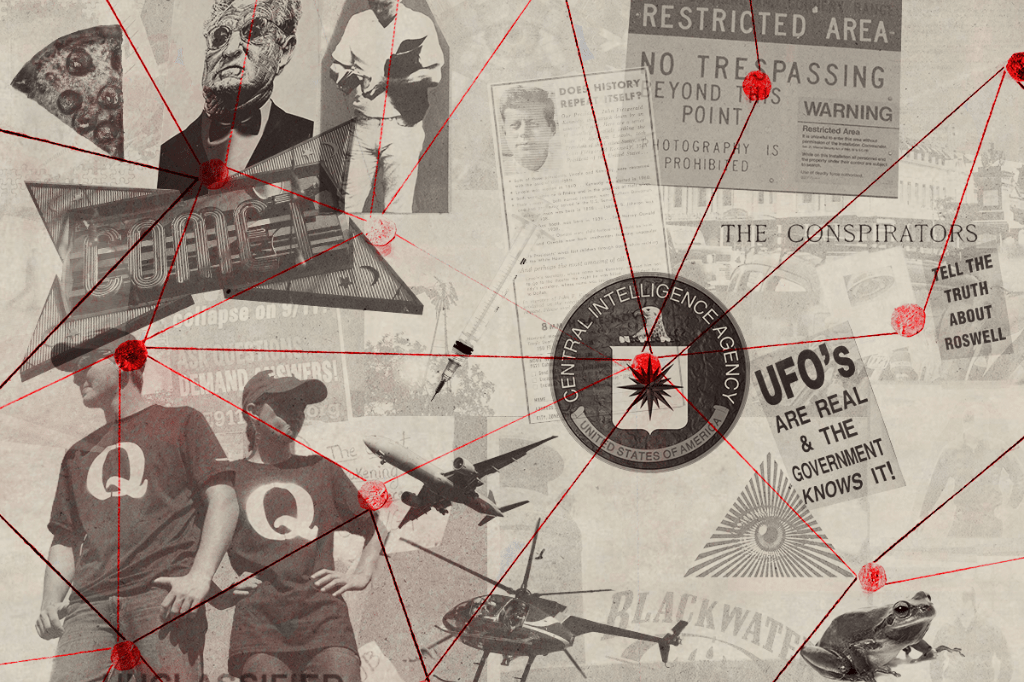
Conspiracy theories have intrigued people for centuries but have often blurred the lines between reality and fiction. These theories upend official accounts of major incidents, claiming that powerful groups secretly predispose events to occur in a certain way to achieve their own hidden ends. But what is a conspiracy theory? How do these assertions catch fire? Why do some conspiracy theories become extremely popular, while others remain far less developed ideas?
This article will define the very notion of a conspiracy theory, present some of the most famous and outrageous conspiracies, and ask why conspiracy theories enthuse millions of people across the globe. We will also look at conspiracy theory documentaries, memes, and real examples of when conspiracy theories were confirmed as true.
What is a Conspiracy Theory?
A conspiracy theory explains an event or situation that involves secret plotting by groups or organizations working behind the scenes. Conspiracy theories often imply that governments, corporations, other wealthy entities hide the “real truth” from the people.
For instance, the major incident of the moon landing suggests that NASA accomplished a mission in 1969. A famous moon landing conspiracy theory suggests instead that the moon landing did not happen, and was staged in a studio.
Conspiracy theories (CT) are characterized by their contradiction to established facts, often arguing these facts are compromised by nefarious circumstances, contradictions, or agendas and deliberate actions to obstruct the perceived truth.
What Makes Conspiracy Theory a Conspiracy?
Not all oddball ideas are considered conspiracy theories. A valid conspiracy theory includes the following elements:
- Concealment – The plan must be conducted out of public view.
- Collusion – A variable or organization must be involved in simultaneous actions.
- Maniplulation – The primary goal is aimed at deceiving and manipulating the target audience.
To illustrate, the many conspiracy theories that surround 911 often argue that a group or government agency was guilty of allowing certain elements of the procedure to happen in complete collusion for political gain. The continuous coded, ongoing manipulation of the facts creates a conspiracy.
Why Are We Attracted to Conspiracy Theories?
The appeal of conspiracy theories tap a deep psychological need. Given the human condition to seek meaning during chaotic, traumatic and confusing times, the natural inclination to find a narrative that satisfies that need often creates the willingness to explore alternatives when the official narratives feel incomplete or inadequate.
Moreover, conspiracy theories provide:
- An opportunity to feel a sense of control in a chaotic environments, by exchanging randomness for thought-out, deliberate behaviour.
- A sense of community for fellow believers to come together, and swap ideas, thoughts, and stories.
- An avenue to reaffirm their sceptic of authority, appealing to those skeptical of institutions.
With social media and platforms like Reddit, the idea of a conspiracy theory seems to flourish and spread rapidly.
The Role of Social Media in the Popularization of Conspiracy Theories
The role of social media and other platforms cannot be understated in the manner in which they make conspiracy theories virulent. Social media allows people to rapidly share and upload ideas through videos, articles, and memes. One of the most powerful instruments of agenda scholarship and propagation is the conspiracy theory meme—a salient or humorous image which condenses and proliferates complex theories with ease through social media.
The contagious nature of memes and forums is both a source of conspiracy theory originality, and additively helps to reinforce echo chambers, which often solidify some believer’s/follower’s ideas and which berate those who think differently. The organic growth of conspiracy theories is hard to debunk and add to their years of circulation within society.
What are the most popular conspiracy theories?
There are some conspiracy theories which possess a great level of popularity and continue to be debated and talked about many years after their original inception. A few examples of these well-circulated and accepted conspiracy theories include:
- The Moon Landing Hoax: The belief that NASA staged the Apollo 1969 Moon landing
- 911 Conspiracy Theories: Various claims that suggest the government is implicated in, or were forewarned of, the 911 attacks.
- The JFK Assassination: Building on the work of conspiracy theorists, that various shorts, or putative co-conspirators, implemented the assassination of JFK.
- Denver Airport Conspiracy Theory: Claims that the airport has secret bunkers for elitist-purchasers and/or hidden stations for chain of command or governmental bureaucracy, or obscure symbols which belong to the ‘Illuminati’.
- Sandy Hook Conspiracy Theories: Baseless claims that the killing and loss of children in a school setting was staged and advanced at the State and Federal level.
These theories have captured public imagination due to their scale, impact, or mysterious elements.
What Are Some Weird, Crazy Conspiracy Theories?
Certain conspiracy theories sound so ridiculous they are almost absurd:
- The Avril Lavigne Death Theory claims that the singer actually died and was replaced by someone who looks similar.
- The Flat Earth Theory denies centuries of science and claims the Earth is flat.
- The Yao Ming Genetic Experiment Theory claims the basketball player was genetically engineered.
Although these theories are often mocked they illuminate how conspiracy thinking can apply to almost anything- no matter how improbable.
What Are Some Conspiracy Theories That Have Turned Out To Be True?
Not every conspiracy theory is false. Some theories exist as reported through investigations:
- Tuskegee Syphilis Study: The US government’s non-treatment of Black men was done to study the progression of the disease.
- MK-Ultra: The CIA’s secret mind control experiments conducted on unsuspecting participants.
- The Gulf of Tonkin Incident: This naval attack in 1964 effectively launched the Vietnam War. Years later, it was revealed that the attack was either made up or exaggerated.
- Iran-Contra Affair: The U.S. secretly sold weapons to Iran (a reported enemy) in the 1980s and funded the Nicaraguan rebels with the proceeds, against U.S. law.
- Bayer Sold HIV-Contaminated Blood
In the 1980s, Bayer sold hemophilia treatments overseas, that were HIV contaminated, after they were pulled off the shelf in America. - Project Sunshine: The U.S. government took body parts from deceased babies and children to study the effects of nuclear radiation, which included taking the tissue without consent from the family.
It must be said that although skepticism is sometimes justifiable it still requires evidence and careful consideration.
The Most Talked-About Conspiracy Theories
1. The Illuminati – Does the Elites Really Control Everything?
The Illuminati is one of the most well-known conspiracy theories out there. Many believe it is a secret society of elite politicians, celebrities, and business people who have clandestine control over world events. They create wars, elections, and everything else to usher a “new world order”.
You will hear names like Beyoncé or Jay-Z, or even U.S. presidents, involved in the theory. You will see symbols, like pyramids, or triangles, or it could even just be the “all-seeing eye” depicted in music videos, or in dollar bills.
As much as we may condemn this belief, there is not much evidence a modern Illuminati exists, but people love to look for clues.
2. Area 51 – What is the U.S. Government Hiding?
Located in the Nevada desert, Area 51 is a top-secret U.S. Air Force base that has been associated with aliens and UFOs for decades. Some believe it is where they’re hiding extraterrestrial technology, even alien bodies.
The intrigue increased when Bob Lazar came forward and said he worked on alien technology near Area 51. The U.S. said it was only a testing site, but that didn’t convince many, especially recently when we’ve seen footage of unexplained aerial phenomena.
Can Conspiracy Theories Be Dangerous?
Yes, conspiracy theories can put people at substantial risk in the real world. For example:
- Families of victims in events like Sandy Hook have faced harassment and hostility from conspiracy believers.
- Public health can be harmed when conspiracy theories contribute to vaccine hesitancy or misinformation about COVID-19.
- Political upheaval can occur when conspiracy theories play a role in delegitimizing election results or government actions.
Understanding that there are emotional and psychological reasons for why someone chooses to believe something can enable society to address a potential danger without necessarily ostracizing that individual.
What are some Titanic Conspiracy Theories?
The sinking of the Titanic has generated conspiracy theories such as the following:
That the ship was sunk deliberately to collect on the insurance.
The Titanic Switch Theory claimed the Titanic had been switched with the sister ship the Olympic prior to sailing.
While historians deem most of these notions nonsense, the Titanic conspiracies exist in discussions, books, and documentaries.
What is the Chemtrail Conspiracy Theory?
The chemtrail conspiracy theory asserts that the government sends out aircraft that release chemicals to affect the weather, control the populations, or run secret tests. Scientists have shown what the public sees are ordinary contrails (or condensation trails) that result from water vapor.
Regardless, the chemtrail conspiracy theory does have many followers, reflecting how fear of unseen powers produces conspiratorial thinking.
Why do people look for conspiracy theories on documentaries?
Documentaries provide good stories, mix facts with speculation, that often promise to “expose” what is often describe as a hidden truth and appeal to people who want to question mainstream narratives.
Documents are either very thorough when examining evidence, or they function more like a blur between factual and fictional evidence that begs for viewer engagement.
How do conspiracy theory maneuvers affect public opinion?
As a medium, memes are quick and accessible to wide audiences. Because memes can merge visual and humor as well as satire with fact, they lend specificity to complex ideas and can be tempting to share. However, if public perception is being molded beneath the guise of jest, there is a trivialization of serious social issues and the dissemination of misinformation.
What are some conspiracy theory iceberg examples?
The iceberg meme organizes theories ostensibly by the degree of popularity or extreme-ness it has become. The tip of the iceberg may include theories like the moon landing, while the other layers can delve into more obscure, ridiculous, or fringe theories. This framework has the capacity to be informative for people new to understanding conspiracy beliefs when unbounded.
What does it mean when people respond with “That’s a conspiracy theory?”
This phrase is sometimes just a means to dismiss ideas that they consider unsubstantiated or paranoid ideations. Nonetheless, we can assume that at times they hear the phrase in sincerity of questioning official narratives Eventually, if we stay civil and encourage critique and dialogue, we might have avenues to explore.
How Do You Know if a Conspiracy Theory is Real or False?
You can evaluate conspiracy theories through the following lenses:
- Source credibility: Do you have a source you can trust, an expert in the topic, or a source with a questionable track record/information ie. “click baiting” sites?
- Evidence: Do you have verifiable evidence to support the theory (included facts, documents, or trusted eyewitnesses) or only anecdotal evidence?
- Logic consistency: Is the theory based on flawed jumps in logic; is the theory based on contradictory information?
- Motivation: Are you aware of the emotional appeal in the theory or attempt to incite fear or anger in you?
It is a balancing act of remaining open but utterly skeptical of insane conspiracy theories.
Conclusion
Conspiracy theories are a complicated cultural phenomenon, fueled by the inherent urge to rationalize the unknowns of life. Conspiracy theories represent a lot of fear and a lot of anxiety; they represent a distrust in authority(the government, social institutions, etc.) and a desire to see explanations and order in chaos. While some conspiracy theories are fun and silly (ie. birds are robotic drones), others can be downright malicious in nature.
In today’s age/contemporary world of information dissemination, understanding how conspiracy theories function, and understanding the normative reasons why they are subscribed to by individuals is important, and understanding critical appraisal of incoming information has never spoken volumes more than the present.
Read about: Why Golden Blood Is the Most Precious Blood Type on Earth?
 Xorvex
Leave a comment