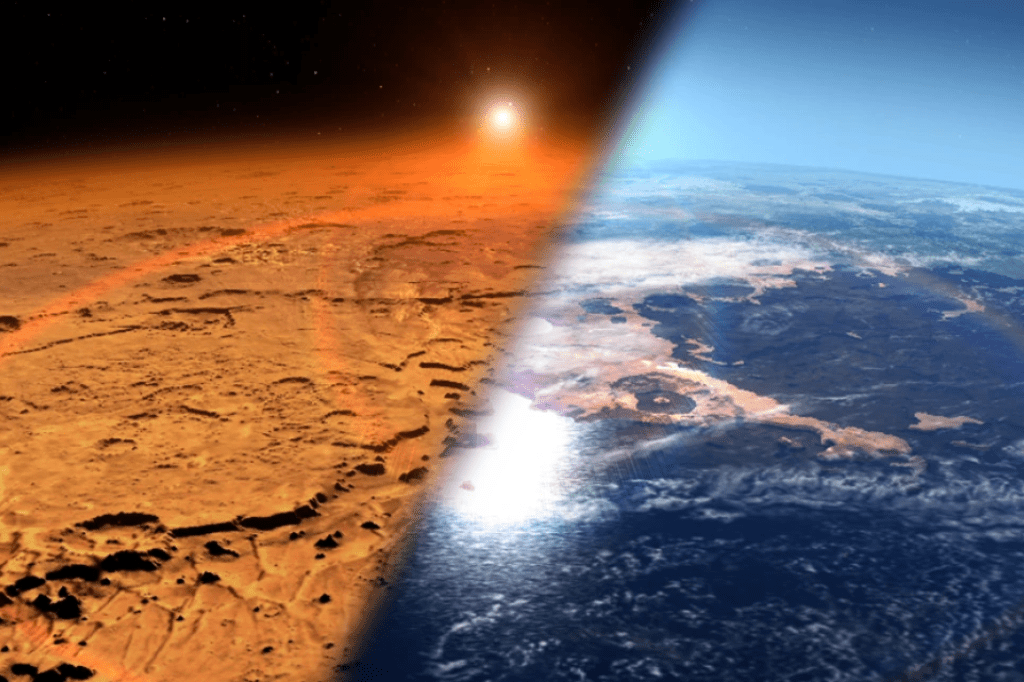
Since time immemorial, Mars has captivated scientists, dreamers, and space agencies. It is the Earth-like planet in our solar system, which is why it is a prominent target in our quest for alien life, future colonization, and understanding our cosmic family. However, one of the lingering issues is whether or not Mars can support life.
To answer that, we need to analyze one crucial aspect: its atmosphere. Mars’ thin, dry, and toxic atmosphere is distinct from the thick, oxygen-rich air on Earth, but that hasn’t stopped scientists from determining whether we could live there one day.
In this blog, we will examine key questions such as:
- Does Mars have an atmosphere?
- What is it made of?
- How did Mars lose its atmosphere?
- Could we ever breathe on Mars?
- Is there life on Mars?
And much more.
Does Mars Have an Atmosphere?
Yes, Mars has an atmosphere, but it is not like Earth’s.
Mars’ atmosphere is incredibly thin, light, and weak. Surface pressure is roughly 0.6% of Earth’s, which is not much to hold air. This thin blanket of gas cannot support life as we know it, nor can it shield the planet from harmful solar radiation or help retain heat at the surface.
So, although it does have an atmosphere, it is not capable of supporting humans without advanced technology and life-support systems.
What Is Mars’ Atmosphere Made Of?
Mars’ atmosphere is primarily made of carbon dioxide (CO₂), with very little oxygen or other elements necessary for human life.
Here’s a breakdown of its composition:
| Gas | Percentage in Mars’ Atmosphere |
|---|---|
| Carbon Dioxide (CO₂) | ~95.3% |
| Nitrogen (N₂) | ~2.7% |
| Argon (Ar) | ~1.6% |
| Oxygen (O₂) | ~0.13% |
| Carbon Monoxide (CO) | ~0.08% |
| Water Vapor, Methane | Trace amounts |
This writing gets to the point: You can’t breathe on Mars. Even with CO₂ filters, oxygen tanks, or other life support gear, it would be practically impossible for any length of time without the right facilities.
Why Can’t You Breathe on Mars?
Mars air hurts humans lungs.
Humans lungs have two significant failure points:
- Too much carbon dioxide – Martian atmosphere has 95% CO₂ – that’s toxic fatal.
- Too little oxygen – Martian atmosphere has less than 0.2% oxygen – Earth has 21% oxygen.
Even if you would survive to cold or radiation the lack of breathable air would kill you in seconds! That’s why all missions to Mars will supply pressurized suits and habitats.
How Warm Would Mars Be With a Thicker Atmosphere?
The surface of planet Mars on average is -63°C (-81°F). In the polar nights the temperature can dip to -125 °C (-195°F)!
One reason Mars is so cold is its poor insulation/ atmospheric large pressure mass. Earth has significant atmospheric mass and greenhouse gases which allow for energy and heat retention through greenhouse effects, Mars simply does not have the atmospheric mass or greenhouse gases to retain heat.
If Mars had a thicker atmosphere, one rich in greenhouse gases like CO₂ and methane, scientists believe it would hold more heat and potentially support liquid water at the surface again.
However, the prospect of warming an entire planet (terrafoming) would take hundreds or thousands of years, and this remains a theoretical issue at this point.
How Did Mars Lose its Atmosphere?
This is one of the most compelling mysteries of planetary science.
Many billions of years ago, Mars may have had a thicker atmosphere, flowing rivers, lakes, and possibly oceans. What happened?
Scientists believe Mars lost its atmosphere in two major events:
- Loss of magnetic field: Magnetic fields are caused by the movement of molten core (e.g., Earth). Mars’ magnetic field was lost billions of years ago. Once lost, the solar winds from the Sun stripped the atmosphere away.
- Low gravity: Mars is about 38% the size of Earth, and its gravity is too weak to keep a thick atmosphere for billions of years.
This atmospheric loss caused Mars to become dry, cold, and inhospitable to life.
How Long Does It Take to Get to Mars?
Getting to Mars takes some time. The timeframe is about 6 to 9 months to get to it – it depends on the angle of Earth and Mars.
Here’s Why:
- Because Earth and Mars travel different speeds in orbit around the Sun.
- The best time to launch to mars is during “opposition” – when Mars is the closest to Earth.
- But even then, spacecraft must follow a curved path (Hohmann transfer orbit) in order to save fuel.
Long travel time is a big challenge for future missions as well – in addition to the exposure to radiation, mental health risks & food/water limits on astronauts.
Is there Life on Mars?
Right now, there is no confirmed life on Mars. But signs to suggest there was life (or might be some underground) in the past.
What we do know:
- There are ancient riverbed and lakebed formations which suggest there used to be liquid water on Mars,
- The Curiosity Rover found organic molecules (building blocks of life) in Martian soil,
- Methane has been some detected in small amounts – which could be formed by microbes or from chemical reactions.
Is Mars Bigger Than Earth?
No, Mars is significantly smaller than Earth.
| Feature | Earth | Mars |
|---|---|---|
| Diameter | 12,742 km | 6,779 km |
| Gravity | 9.8 m/s² | 3.7 m/s² |
| Surface Area | 510 million km² | 144 million km² |
| Mass | 5.97 × 10²⁴ kg | 6.42 × 10²³ kg |
Mars is pushing its ability to retain atmosphere and liquid water — two important parts of it not being an a suitable environment to sustain life — due to it’s relatively small size and weak gravity.
What Is the Atmosphere on Mars Like?
In summary:
- It is very thin (less than 1% of Earth’s pressure).
- It is dominated by carbon dioxide.
- It is cold, dry, and offers no protection against radiation.
- It has episodic dust storms which can last for weeks, and can cover the whole planet.
The atmosphere allows for weather, but not on Earth scale — there are winds, clouds, and even temperature variation, but the conditions do not allow humans to survive unprotected on the Martian surface without pressure suits or habitats.
Could We Ever Live on Mars?
Living on Mars would require massive technological barriers:
- Needs artificial habitats – so, humans can live without, O2, heat, or protection from radiation
- Developing food production systems – maybe using hydroponics.
- Water recycling and water extraction, which could also occur from underground ice.
- Reliable transportation between Earth and Mars.
There are experts who say colonisation could happen in less than 100 years, others would argue that Mars is so hostile a environment, that we should preserve our earth, not presently forfeiting its till we terraform a dusty barren world.
Mars vs Earth – Where should we make the investment?
Let’s be honest; Earth is still the best place to be living despite its challenges.
Instead of investing everything to attempt to colonise Mars, many scientists would rather see us invest our resources into climate change, pollution, and inequalities here on Earth.
This is not to say we should not explore – Mars is a rich source of information with respect to planetary evolution and the potential for extraterrestrial life. However, it may not be the relief valve some people are looking for.
Frequently Asked Questions
Q: What is the composition of the atmosphere of Mars?
A: Approximately 95% carbon dioxide, with a mixture of nitrogen and argon, with very little oxygen.
Q: Can humans breathe on Mars?
A: No. The air is toxic and lacks oxygen necessary for humans to breathe.
Q: Is there water on Mars?
A: Yes, in the form of ice, and there may be liquid water deep underground.
Q: Can we terraform Mars?
A: In theory, yes. However the process would take centuries and cost tremendous amounts of money and resources.
Conclusion
Does Mars have an atmosphere? Yes – but it’s thin, poisonous, and unbreathable. Can it support life? Maybe microbial life underground, but certainly not humans without a coordinated support structure. Is it bigger than the Earth? No. Can we get there? Certainly, but living there is another story altogether.
Mars will continue to fascinate us. However, before we start dreaming of building houses on the Red Planet, we should remember: Earth is still our only real home – and we must save it first.
Read about: Why Veganism is Trending and Why Millions Are Choosing it?

 Xorvex
Leave a comment