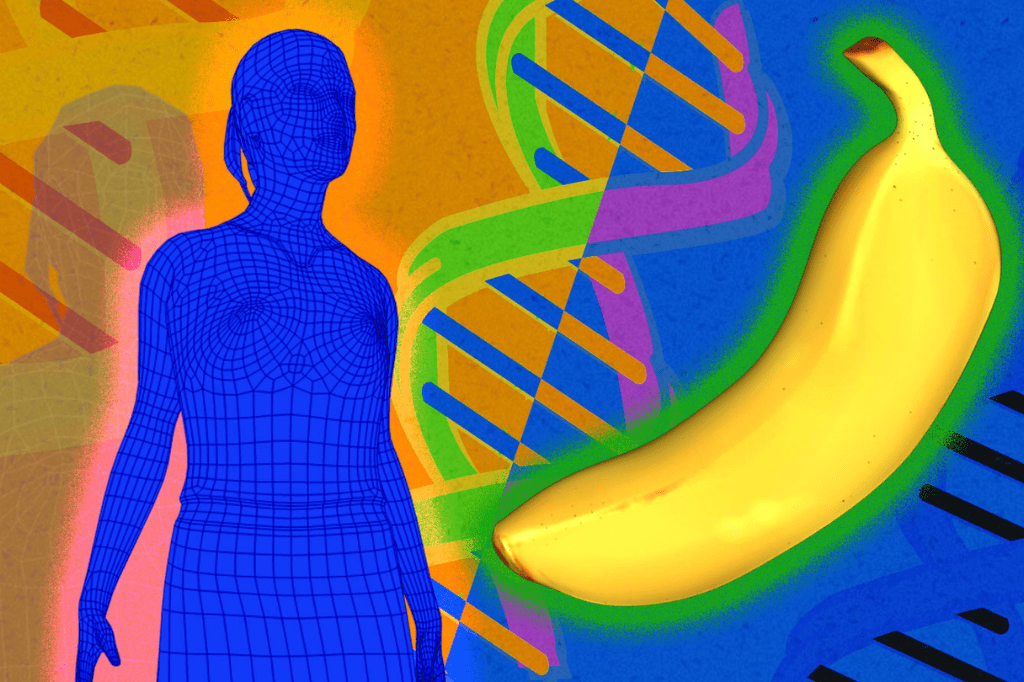
You peel a banana, take a bite, and probably never think, “I’m genetically similar to this.” But, science says you are. Believe it or not, humans share up to about 60% of our DNA with bananas. That’s right!
Sounds crazy, but it is not as wild as you may think. In this blog, we will discuss what “sharing DNA” with a banana means, why there are so many things sharing genetic connections, and how this finding has changed the way we view evolution, biology, and biotechnology.
What Does “Sharing DNA” Actually Mean?
First things first, sharing DNA doesn’t mean humans and bananas are 60% similar in looks or behaviors. It means that roughly 60% of the genes that are in bananas also exist in the human genome. Genes that perform similar functions, such as generating energy, or controlling cell functions.
DNA is made up of sequences of four nucleotide bases: A (adenine), T (thymine), C (cytosine), and G (guanine). Every living being on Earth, from bacteria to blue whales, uses exactly the same language.
When scientists say humans and bananas share 60% of DNA, they are saying there are some same basic building blocks and functions between the two species, even if they look nothing alike.
Why Do Humans and Bananas Share DNA?
It is because of evolution and common ancestors. All life on Earth has an origin of some sort. Life evolved from that origin into billions of different forms, but certainly the same basic instructions to make life—like copy DNA, repair cells, or make proteins—have stayed relatively similar.
Therefore, the reason we share DNA with bananas is not because we all evolved from bananas (don’t worry) but rather humans and bananas both inherited genes from ancient single-celled ancestors. And because functions necessary for life are universal, those genes have been preserved across species. For example:
- Both humans and bananas have genes that code for cell division.
- Both use similar mechanisms for energy production.
- Both repair damaged DNA.
It’s biology’s “don’t fix what ain’t broke.”
What Percentage of DNA Do Humans Share with Other Life Forms?
Bananas aren’t the only surprising genetic relatives we have. Here’s a fun breakdown:
| Species | DNA Shared with Humans |
|---|---|
| Chimpanzees | ~98.8% |
| Mice | ~85% |
| Dogs | ~84% |
| Cows | ~80% |
| Bananas | ~60% |
| Fruit flies | ~60% |
| Yeast (used in baking) | ~31% |
Strangely enough, these similarites help researchers learn about diseases, develop medicines, and understand genes.
How do researchers measure shared DNA?
Researchers compare whole genomes (the complete set of DNA of an organism) to locate homologous genes (genes inherited from a common ancestor). Using sophisticated software, these researchers align sequences from different species to find where the following are similar:
- Gene structure
- Protein-coding regions
- Regulatory functions
Once matches are made, scientists determine the percentage of DNA that is, “shared”.
But here’s the kicker: when we say “60% shared”, we understand that these genes do not necessarily do the same thing in the two species, the function might be similar (i.e. energy metabolism), however expression can vary greatly, depending on the organism.
Why Is This Information Important?
The fact that humans and bananas (and mice and yeast) share so much DNA illustrates a basic truth about life:
We are all more connected than we think.
This knowledge has enormous implications:
- Medical Research – By being able to study diseases in animals (in ways that mimic that human condition).
- Agriculture & Biotechnology – Knowing how plants work genetically can help us improve yields, disease resistances, and nutrition.
- Evolutionary Biology – We can create a clearer picture of how life arose and adapted.
- Synthetic Biology: Using shared genetic mechanisms, scientists can manufacture high-value compounds (insulin, for example) using bacteria or yeast.
Fun Facts You Probably Did Not Know
Bananas have approximately 36,000 genes, while humans have about 20,000–25,000 genes. Humans and bananas share about 60% of DNA; we also share about 50% of DNA with cabbage and 40–50% of DNA with flies.
If you stretched all of the DNA in your body end to end, it would reach the sun and back over 300 times. Bananas are triploid, meaning they have three sets of each chromosome, which is why they do not reproduce via seeds any longer.
Are Humans Basically Bananas?
Not quite. Although we share approximately 60% of DNA bases, bananas still are bananas, while humans are still humans. Our similar DNA is really a reflection of how fundamental life processes are conserved in evolution, and do not mean we are genetically identical.
However, this similarity does bring us back to a fairly profound thought: life on Earth shares a common genetic language, and we are all writing our stories using the same shared alphabet.
Conclusion: From Fruit to Family Tree
Next time you peel a banana, remember: it’s not just food—it’s your long-lost cousin (molecularly speaking, at least).
It may be amusing to think we share 60% of our DNA with bananas, but it stands as one of the most intense examples of life’s interconnectivity. Whether in our fruit bowls or in the fossil record, DNA serves as a brilliant reminder we are a part of a much larger biological family.
Read about: What Is DNA and How Does It Work?
 Xorvex
Leave a comment