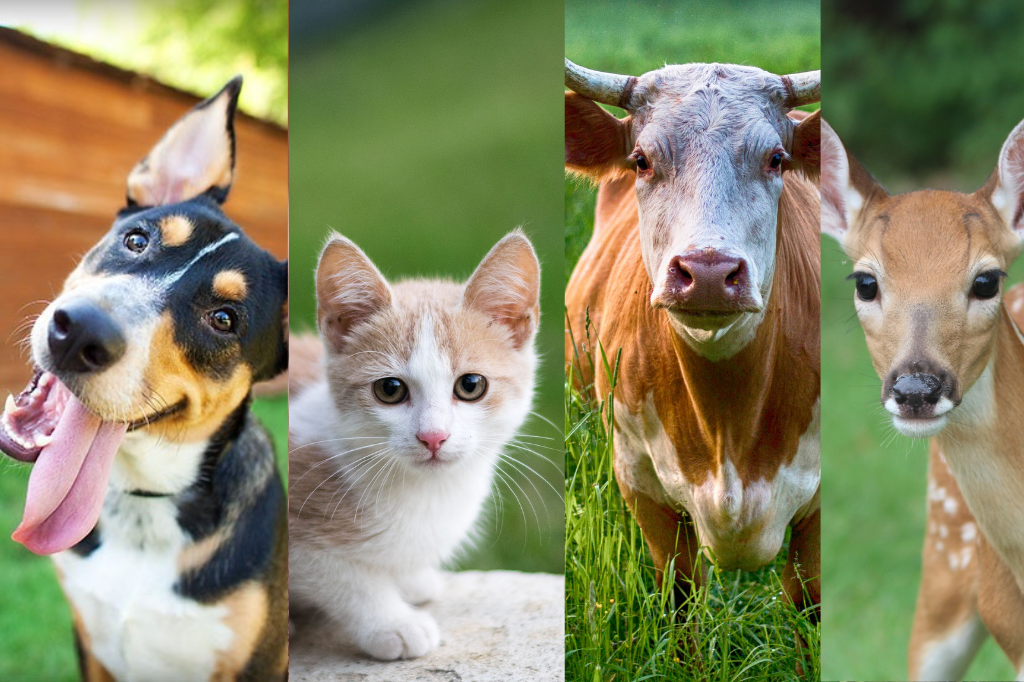
When we think of animals, we usually imagine something as vibrant as what we see in the animal kingdom: green leafy forests full of colorful flowers, bright-feathered parrots, etc. But not every living creature sees the same rainbow we do! While we humans see color using three types of cone cells, we see this wide range of color, and animals vary widely in the way they see and detect colors.
This brings us to one of the most searched questions on the internet: Are animals color blind? What about specific animals like dogs, cats, deer, bulls, birds, etc. Lets overcome and breakdown the science of animal vision by each species.
What Does “Color Blind” Mean in Animals?
Color blind does not always mean color blind. Most animals are not blind to all colors, but rather one of the major factors that will determine whether and how an animal can see certain colors is how many cone cells(color receptors) they have in their eyes.
- Humans: Trichromatic (red, green, blue).
- Many Animals: Dichromatic (two cones).
- Some Birds/Fish: Tetrachromatic (4 cones, often with UV vision).
- Deep Sea: Monochromatic or entirely relying on the aspects of light/dark contrasts.
Understanding these differences is key in answering the following questions to list a few:
- Are dogs and cats color blind?
- Are deer red-green color blind?
- Are birds or fish able see more colors than us?
Are All Animals Color Blind?
From the sharp ultraviolet vision of birds to the gray-toned world of sharks, animals perceive color in dramatically different ways. To understand these differences at a glance, here’s a quick comparison of how various species see the world around them:
| Animal | Color Vision Type | See Red/Green? | Special Trait |
|---|---|---|---|
| Dogs | Dichromatic | ❌ | Great motion detection |
| Cats | Limited trichromatic | ❌ | Amazing night vision |
| Deer | Dichromatic | ❌ | Low-light sensitivity |
| Bulls | Dichromatic | ❌ | React to movement, not color |
| Birds | Tetrachromatic | ✅ | See UV light |
| Fish | Varies | ✅ | Some see UV & more |
| Horses | Dichromatic | ❌ | Wide field of view |
| Rabbits | Limited | ❌ | Strong motion detection |
| Sharks | Monochromatic | ❌ | Detect contrast in deep water |
| Chickens | Tetrachromatic | ✅ | Exceptional color perception |
| Cows | Dichromatic | ❌ | See blue/yellow only |
Now that we’ve seen how different animals experience color at a glance, let’s take a deeper look at what this actually means for each species, and how their color perception shapes their interaction with the world.
Are Dogs Color Blind?
Yes, and no. Dogs are not entirely color blind. Instead, their vision can be defined as dichromatic, indicating they can see two ranges of colors, specifically blue and yellow. What they cannot see is red and green. So to a dog:
- A red toy would look like a dull brown or gray color.
- A green lawn would likely look more yellow-ish.
Are all dogs color blind?
Yes, all dog breeds share the same structure of vision, meaning their limited color range is the same.
Despite this, dogs are better at detecting motion and low light which can be a more effective survival trait than seeing all the colors in the world.
Are Cats Color Blind?
Cats are not completely color blind, but they do not see in full color like humans do.
Mainly, cats have limited trichromatic vision, and the assumption is that they see some shades of blue and green, but the red and pink gradient appears gray or dull brown in a cat’s eye. However, what cats lack in color they certainly make up for in their:
- Night Vision.
- Motion Detection.
- Peripheral Vision.
Their eyes are designed for hunting, not for watching sunsets.
Are Deer Color Blind?
Yes – deer are red-green color blind. They can see blue and possibly some yellows, but reds and oranges look like a grayish or brown. This is why hunters wear blaze-orange clothing. It shows up as a color to human eyes, but not to deer.
Deer have eyes it can locate movement and identify predators in low-light conditions—helping them recognize threats better at dawn and dusk.
Are Bulls Color Blind?
Yes, and this clears up a major myth. Bulls do not hate red. Like other large mammals, bulls are dichromatic. They cannot see red at all. In bullfighting, it is the movement of the cape that gets the bull to charge, not the color.
So saying bulls “see red” is actually not accurate because they don’t!
Are Birds Color Blind?
Not really – birds have some of the best color vision of any animal.
Most birds are tetrachromatic (meaning they can see 4 primary colors), including the ability to see ultraviolet light, which humans cannot see at all. This superpower helps them:
- Tell ripe fruit from unripe,
- Determine where their mates are,
- and Navigate by the UV patterns in feathers and plant life.
So birds are not color blind – they are color superheroes.
Are Fish Color Blind?
It depends on the species. For example, some fish such as the goldfish possess tetra- or even pentachromatic vision capabilities, meaning they are capable of seeing a broader color range than humans!
Fish living in deep water and murky environments are likely less dependent on color than they are contrast and brightness. Tropical fish have evolved bright coloration to attract mates or warn other fish; thus, color is important to the function of their life.
Are Horses Color Blind?
Yes, horses are dichromatic, similar to dogs. They see blue and green well, but reds do not appear to them as red and are more muted or grayish. The fact they have limited color vision does not matter much because they have a wide field of view, as well as being extremely good at detecting motion: a perfect prey animal!
Are Rabbits Color Blind?
Rabbits are not color blind, but their color vision is limited. They may see some blue and green, and reds and oranges appear gray. They also are more reliant on the use of their peripheral vision and the detection of motion, as can be seen with their eyes being located on the side of their head.
Are Sharks Color Blind?
Yes, most sharks are monochromatic, which means they only see in shades of gray.
Why? They inhabit dark, deep waters where light and color don’t travel well. Instead of using color, sharks rely more on:
- Contrast vision
- Vibration detection
- Smell
So, your colorful swimsuit? Probably undetectable by a shark’s eye.
Are Chickens Color Blind?
Surprisingly, no. Chickens have good color vision. In fact, they may have even better color vision than us.
- Chickens are tetrachromatic, meaning they can see UV light.
- They also do this to help them determine food, mates, and social information.
Their bright feathers and combs aren’t just for show; they’re used in a complex system of visual communication.
Are Cows Color Blind?
Like most mammals, cows have dichromatic vision. They can see blue and yellow, while red and green probably appear gray or dull.
Cows’ perceptions of the world are based more in shape, motion, and brightness than color, which suits their lifestyle as grazers.
Conclusion
While we take in colors of the spectrum, the majority of animals see in a more narrow and practical way. Animals see not for wonderment, but out of necessity—cueing into light in low sources in order to spot and avoid predators, following prey from motion in shadowy settings and flying in components of UV light as visual cues.
When you throw a red ball for your personal dog, or think about that magnificent rooster in your backyard, remember that they are seeing something different; just as cool.
Read about: Is This the End of Dollar Dominance? BRICS De-Dollarization Movement
 Xorvex
Leave a comment