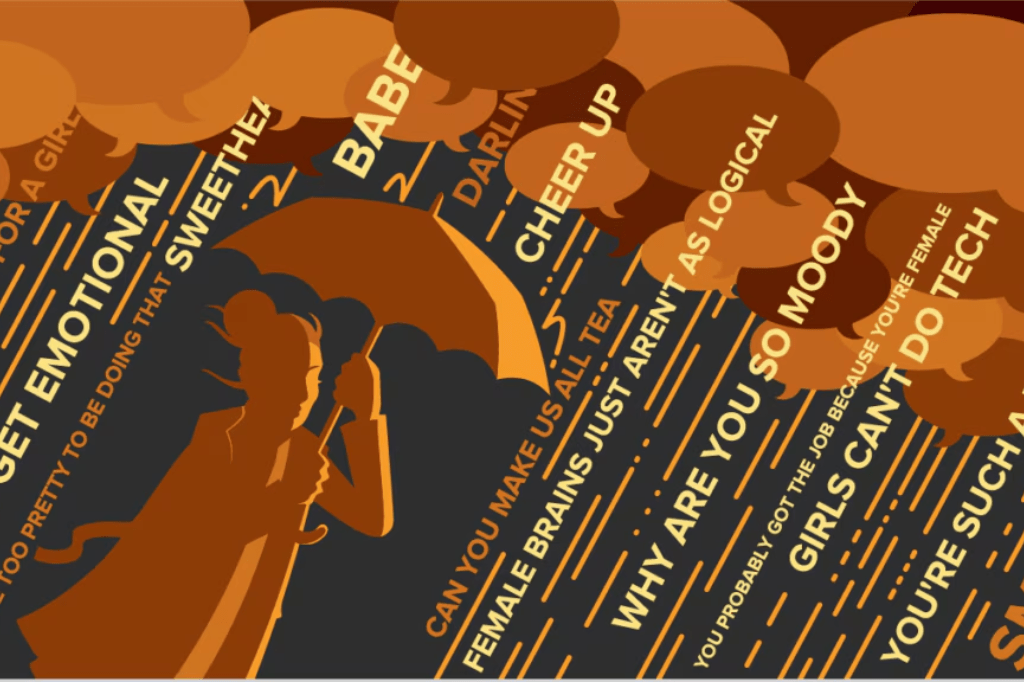
Sexist attitudes may have become less mainstream over the last several decades but continue to infest society through jokes, inequity in pay, media narratives, structural hierarchies in the workplace, and even laws. From mansplaining to maternity discrimination, sexism is normalized in many societies to the extent it is often unconscious—dismissed as tradition or biology or simply “the way things are.”
So, how did we get here? Why is it so hard for sexism to be disentangled from our societies? To fully appreciate how and why sexism is normalized, we can first examine what sexism actually is and the variety of expressions it takes. This blog will examine the definition of sexism, its effects and roots, as well as how sexism impacts both men and women, how it appears in variances of culture and why it persists.
What Is Sexism?
Sexism can be defined as discrimination because of a person’s sex (or gender). Most commonly, it refers to the belief that one sex (normally male) is better than another (normally female).
In other words, sexism refers to an entire system of beliefs and behaviours which create power imbalances between the sexes that impacts opportunities, safety, representation, and dignity.
How is Sexism Normalized?
Sexism is normalized whenever it is embedded within cultural narratives, law, employment policies and practices, family structures, and religious doctrines. Here’s how:
- Historical Foundations – The U.S. legal system, from voting laws to workplace policies, was built with male dominance in mind. Women couldn’t vote until 1920. Until the 1970s, women couldn’t even get credit cards without male co-signers. These precedents shaped societal expectations.
- Cultural Conditioning – From a young age, people are inundated with messages about how ‘boys’ and ‘girls’ ought to behave. Boys are told to be strong and assertive; girls are told to be calm and pretty. Ultimately cultural expectations surrounding gender roles are reinforced over time, shaping expectations in schools, workplaces, and relationships.
- Representation in the Media – Movies, ads, and cartoons all have embedded sexist tropes that are continually reinforced through sexualized depictions of women, dependent depictions of women, and viewed emotional depictions of women. Men are rarely depicted as vulnerable or nurturing. Normally we receive these images uncritically and unconsciously reinforce a gender hierarchy.
- Religious/Traditional Norms – Many societies have linked gender roles to religious or ‘natural’ principles: ‘Men should be protectors’ or ‘women should be caregivers’ are often construed as divinely inspired or biologically predetermined statements we are discouraged from questioning or challenging.
- Lack of Accountability – Sexist comments or behavior constantly surfaces and are often dismissed in the form of joking or generational mannerisms that are difficult to challenge or modify, especially in male-dominated environments.
- Disparities within the Workplace – Sexism is systemic to workplaces but has been normalized through wage gaps, glass ceilings, pregnancy penalization, and toxic office culture. Many professions still ask: How does sexism impact equality in the workplace? Women are suffering profoundly and systemically.
What Are Benevolent & Hostile Sexism?
Sexism isn’t always overt or aggressive.
Sexism isn’t always overt or aggressive.
- Hostile sexism is the obvious kind: derogatory comments, exclusion, or violence.
- Benevolent sexism is more subtle. It appears as “positive” stereotypes (e.g., women are nurturing, so they shouldn’t work night shifts), but still limits autonomy.
Which of the following is an example of benevolent sexism?
“Women should be protected and cherished by men.”
This may sound polite or even flattering, but it’s a textbook example of benevolent sexism. While it appears positive on the surface, it reinforces traditional gender roles that cast women as weak, dependent, or in need of male guidance.
| Statement | Why it’s Benevolent Sexism |
|---|---|
| “Women are naturally more nurturing than men.” | Stereotypes women as caregivers, limiting career options or autonomy. |
| “A good woman knows when to let a man lead.” | Implies male dominance is natural or preferred. |
| “Men should pay for everything on a date.” | Suggests men are providers and women are dependent or passive. |
Many Americans mistake benevolent sexism for kindness. For instance:
- “Women are naturally better at cooking.”
- “Let me carry that, you’re too delicate.”
- “She’s too pretty to be taken seriously.”
Benevolent sexism is harmful because it’s socially accepted and often goes unchallenged, making it harder to detect but just as damaging as hostile sexism.
Is Sexism the Same Thing as Sexual Harassment?
People often ask, “Is sexism sexual harassment?” Not exactly.
- Sexism as gender-based prejudice, or discrimination.
- Sexual harassment involves unwanted behaviors of a sexual nature (e.g. comments, touching).
Sexual harassment, however, is supported by sexist beliefs that one sex has privilege of the other.
What Is Ambivalent Sexism?
Ambivalent sexism is the combination of hostile sexism and benevolent sexism. For example:
- A man may say women are nurturing, and then say women shouldn’t be CEOs.
- Or, some boss may praise a female employee’s looks, but question her leadership skills.
Ambivalent sexist beliefs are dangerous because they present confusing, contradictory, and complex messages, making it more difficult to confront.
What is the difference between sexism and misogyny?
Some individuals may ask “Are misogyny and sexism the same?” Not really.
- Sexism is broad based bias based on gender (which impacts anyone).
- Misogyny is hatred or contempt for women.
All of misogyny is sexist, but not all sexism is misogynistic.
How Does Sexism Affect the U.S. Economy?
Hundreds of billions are lost every year due to the gender pay gap in the U.S.
We uncounted women’s unpaid labor in the GDP, such as caregiving and domestic work.
Exclusive or sexist hiring practices result in the underutilization of female talent.
More equal societies are better for everyone: socially, emotionally, and financially.
How to Reduce Sexism?
Some users are searching “how we can alleviate or reduce sexism” or “how to reduce sexism in the workplace.” Here’s a systematic way to eliminate sexism:
Education
- Implement gender studies in schools.
- Teach about consent, respect, and emotional expression to children.
Policy
- Pass legislation on pay transparency.
- Ensure paid parental leave is federally mandated.
- Enforce anti-discrimination policies.
3. Representation
- Elect more women and gender-diverse leaders.
- Support media that portrays gender accurately and respectfully.
4. Personal Action
- Call out sexist jokes.
- Challenge gender roles in your own home.
- Uplift women’s voices—especially in male-dominated spaces.
Can Men Experience Sexism?
Yes! Although sexism disadvantages women more, men can also experience sexism if they do not follow social constructs of masculinity:
- Stay-at-home dads are sometimes teased.
- Males working in the nursing, teaching, or dance professions may endure stigma.
- Being labeled “weak,” is often given when you show emotion, which can be a secret boast of masculine incompatible concepts.
Sexism is also restrictive to everyone, but prescribes rigid behavior.
How Does Sexism Affect Men and Women Differently?
| Area | Women | Men |
|---|---|---|
| Workplace | Pay gaps, glass ceiling, harassment | Caregiving stigma, toxic competitiveness |
| Mental Health | Anxiety from unrealistic expectations | Emotional suppression, suicide stigma |
| Media Portrayal | Sexual objectification, unrealistic beauty standards | Pressure to be dominant, lack of emotional representation |
| Relationships | Pressure to nurture, carry emotional labor | Pressure to lead, provide, suppress vulnerability |
Is There Still a Lot of Sexism in the U.S.?
Despite strides:
- 1 in 3 women in the U.S. get harassed in the workplace.
- Women occupy only ~10% of Fortune 500 CEO positions.
- Women comprise only 20% of Congress (as of 2025).
- For black women, latinas, and indigenous women, there are even greater disparities.
Does reverse sexism exist?
“Reverse sexism” refers to the idea that men are now under discrimination. Although some individual men may be led to believe that they face bias, there has never been systemic or historical oppression of men on the basis of gender like that which women have experienced.
It is important to talk about issues that affect men, as long as we don’t compare this to centuries of patriarchal oppression.
How did Sexism Start?
Sexism in America was born out of:
- Colonial era laws that regulated women as property.
- Religious texts, such as the Bible, that legitimized male authority.
- 19th-century medical itemizations that qualified women to be hysterical and ones of inferior quality.
- Post-WWII, women were pushed out of jobs and deemed fit only to reside in the kitchens to tend their families.
With knowledge of the founding of these ideas and behaviors, we can begin the process of dismantling.
How long has sexism existed?
Sexism has been around for thousands of years. But every generation has the power to push back against it, and reshape what’s considered normal.
Conclusion: Why Challenging Normalized Sexism Matter
Sexism isn’t always loud or violent. Sometimes it’s just a raised eyebrow, a non-promotion, a joke, or a compliment that patronizes. That’s what makes it so dangerous—it can hide in plain sight.
But change is happening. Through conversation, education, and audacious policy progression, we can start to disrupt what has been normalized for too long. Each step matters—whether it’s fostering empathy for our sons, or advocating for women’s voices to be amplified in the corporate boardroom.
Read about: Can a Husband Really Stop His Wife from Leaving Iran?
 Xorvex
Leave a comment