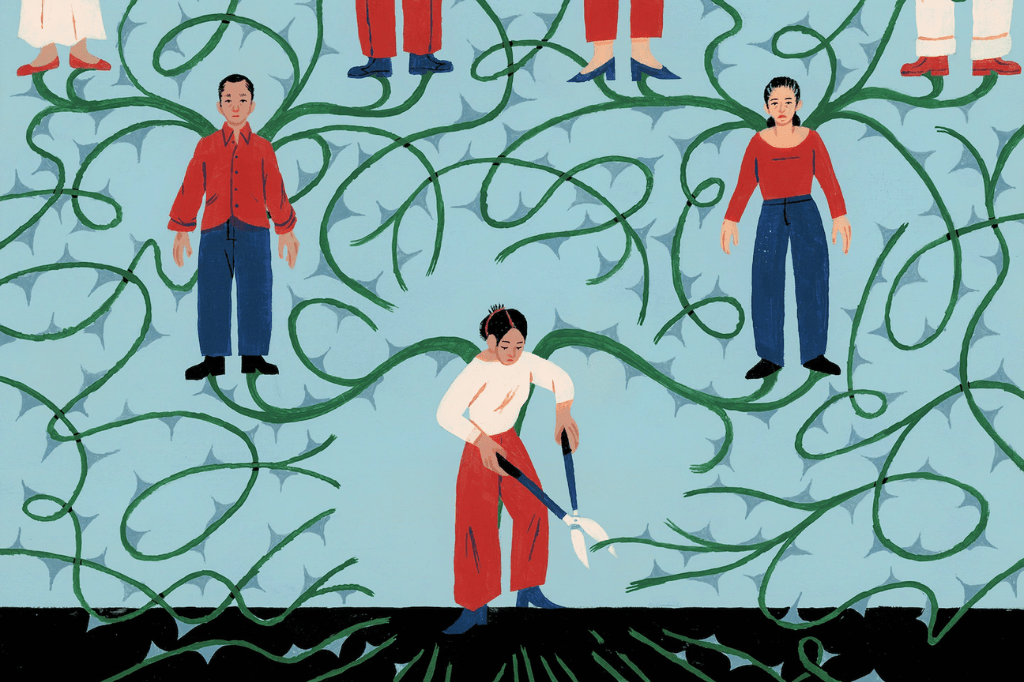
You don’t just inherit eye color or a voice from your mother, you inherit pain, too.”
Many of us grew up in homes where quiet was louder than words. Where emotional wounds remained unnamed and family pain felt like an heirloom. There may have been phrases you heard like “that’s just how we are,” or “our family doesn’t talk about that.” But what if that unspoken thing came from a longer lineage of something referred to as generational trauma?
What Is Generational Trauma?
Generational trauma (also known as intergenerational trauma) is the emotional, psychological, and sometimes, physical effects of trauma that is transferred through generations. Generation trauma doesn’t have to be experienced directly to affect someone; it can be passed on through parenting, modeling behaviors and coping responses, silence, and even biology.
Generational trauma may originate from significant traumatic events such as:
- Slavery or colonization
- War and genocide
- Domestic violence or abuse
- Addiction or suicide within the family
- Forced displacement and migration
- Systemic racism and poverty
What does generational trauma mean?
It means that unresolved trauma in one generation may appear in the behaviors, emotions, relationships, and in some instances, health conditions of the next generation, even if that generation hasn’t experienced it directly.
Is Generational Trauma Real?
Yes, there is generational trauma, and it’s an idea that is gaining traction in scientific and psychological studies and research studies. There is a considerable amount of research studies on:
The children of Holocaust survivors with a higher incidence of anxiety, PTSD.
Indigenous populations who are still recovering from colonialism and losing their culture.
The descendants of Black Americans, who still suffer the trauma of slavery, segregation, and systemic racism.
Refugees, with children thinking about their trauma/misery of war, displacement, and poverty.
Is Generational Trauma Scientifically Proven?
A recent field of research called epigenetics is showing that trauma could leave chemical “tags” on our DNA which are epigenetic markers. Epigenetic markers are not changes to the DNA itself, they alter the way genes are expressed, specifically in relation to the genes that help with regulation for stress.
Simply put, if your parent or grandparent has a history of acute trauma, they may pass on the stress responses in a biological way leaving the next generations more susceptible to anxiety, depression, and/or creating hyper-vigilance to stress.
Can Trauma Be Passed Down Through Generations?
Yes. Trauma can be passed down:
- Psychologically by children for example displaying emotional repression from their parents, overprotectiveness by a parent, or aggressive parenting
- Socially by children becoming aware of sensitive topics and the silence of avoidant families.
- Biologically through children having different stress responses in their nervous system because of previous trauma.
How does generational trauma get passed down?
This can include:
- Inherited ideas: “You can’t trust anybody,” “Never show weakness,”
- Behavior modeling: observing a parent struggling with rage, addiction, or dissociation,
- Cumulative silence: children absorb this anxiety and fear even if nothing is expressed verbally.
What Are Examples of Generational Trauma?
Here are some actual examples of patterns we may see:
- A woman raised by her mother, a survivor of domestic abuse, who becomes overly-anxious in relationships despite being unaware of having experienced direct abuse.
- A man whose grandparents survived a war, who may experience panic attacks during loud noises or conflict, not realizing why.
- Families who exhibit little or no emotional connection may be manifesting the generational grief and shame that they inherited.
How Do I Know If I Have Generational Trauma?
Ask yourself:
- Do patterns of emotion repeat in your family?
- Do you experience anxiety, fear, or guilt that has little to do with anything you have experienced in your lifetime?
- Does your household have unexpressed grief, or unspoken topics deemed taboo?
- Are there family-wide forms of toxic coping mechanisms that have become culturalized into your family over generations?
If the answer is yes, you may be carrying emotional baggage that isn’t yours to manage.
How Many Generations Can Trauma Be Passed Down?
There isn’t exactly a number, but research indicates that trauma can be inherited across three to four generations or more. This ranges in relevance with regard to communities facing historical trauma– such as Native Americans, descendants of enslaved individuals, and individuals and families who have faced violence, poverty, and displacement due to war.
What Is Considered Generational Trauma?
Generational trauma can be described as trauma that any one generation experiences, but fails to heal or completely process, and is then unintentionally passed on to the next generation. Generational trauma can be considered trauma that is inherited through the generations, including:
- Emotional neglect
- Cycle of substance abuse
- Repressed anger or shame
- Learned helplessness or hopelessness
Ongoing anxiety about safety, money, or relationships
How Childhood Trauma Affects The Next Generation?
Children of parents who have been traumatized may experience inconsistent caregiving, emotional neglect or, hyper-responsibility.
The household may normalize a survival type of behaviours such as distrust, people pleasing, emotional shutting down, etc..
With no intervention, children often continue the same trauma cycle into adulthood.
How Does One Heal from Generational Trauma?
How Do You Heal Generational Trauma?
Healing is possible — but it requires courage, awareness, and intentional action. Here’s how:
1. Acknowledge the Pattern
Naming the pain is step one. You can’t heal what you don’t acknowledge.
2. Talk About It
Discuss family history with older relatives if possible. Understand what your parents or grandparents went through.
3. Go to Therapy
Find a therapist who specializes in:
- Intergenerational trauma
- EMDR (Eye Movement Desensitization and Reprocessing)
- Somatic therapy (healing through the body)
- IFS (Internal Family Systems)
4. Inner Child Work
Reconnect with your younger self. Understand what your inner child needed but didn’t get.
5. Break the Cycle
Say no to repeating harmful behaviors. Set new family norms around communication, love, boundaries, and emotional expression.
What Are Some Books on Generational Trauma?
- “It Didn’t Start With You” by Mark Wolynn
- “The Body Keeps the Score” by Bessel van der Kolk
- “My Grandmother’s Hands” by Resmaa Menakem
What About Pop Culture?
Is Encanto About Generational Trauma?
Yes, The Disney film Encanto beautifully portrays the burden of unspoken family expectations and the healing power of acknowledgment and love.
Is Turning Red About Generational Trauma?
Yes, especially regarding mother-daughter dynamics, repression, and emotional inheritance in Asian immigrant families.
FAQs
1. Can Generational Trauma Be Genetic?
Yes, in the way that trauma may affect the way your genes behave (specifically the genes associated with stress, immunity and emotional regulation). This is called epigenetics, and while it is a growing field of research, it offers biological proof of emotional inheritance.
2. What Generation Has the Most Childhood Trauma?
Numerous studies indicate that Millennials and Gen Z report the most amounts of childhood trauma (including generalized anxiety and depression) . However, this could be known to indicate both an increase in stress, and an increase in awareness and dialogue regarding mental health.
3. Can Trauma Survive Generationally?
Yes. Even without discussing trauma, the aspects of trauma linger on — in behaviour, fears, relationship problems and coping mechanisms.
Conclusion: Can Generational Trauma Be Healed?
Yes. And it can start with you. Healing generational trauma doesn’t mean fixing your family or erasing the past, it means creating a future where you and those after you can live with more peace, understanding, and emotional freedom.
Breaking the cycle is hard, but it’s also sacred.
Read about: Is Tipping Culture Out of Control Practice and Controversy
 Xorvex
Leave a comment