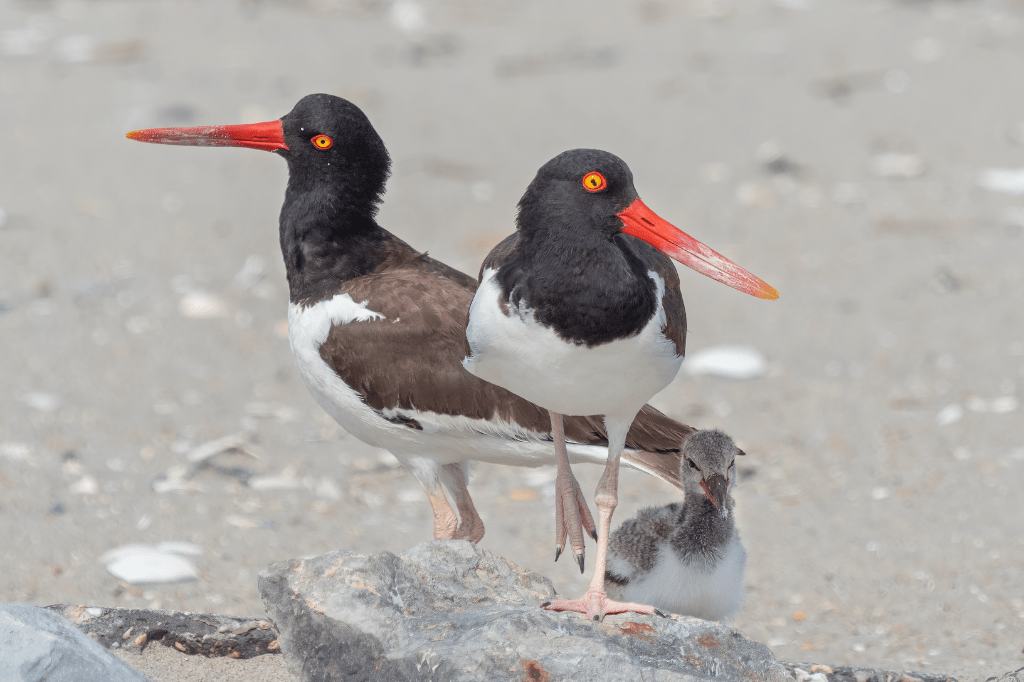
With their striking black-and-white plumage, bright orange bills, and loud calls ringing out from the shores of North and South America. American Oystercatchers are some of the most visually stunning birds you’ll see during your time on the coasts of North and South America. However, beyond their appearance, many people who love birds ask:
Do American Oystercatchers Form Attachments to Their Mates?
Certainly! American Oystercatchers are considered monogamous species. They almost always form a long-term tendencies, and usually return to the same mate from a previous nesting season, especially if both individuals survived the winter migration and returned to the same nesting territory.
Do They Stay With One Mate for Life?
While not always strictly speaking “for life,” many pairs remain together for several breeding seasons and their partnerships are shown to be long lasting and loyal, particularly good for those breeding seasons, when nesting sites are stable, and both partners remain healthy.
Why Do They Reunite With the Same Mate?
It is not sentimental it is practical. The benefits of forging ties and reuniting with the same partner include the following:
- Stronger communication and coordination.
- Less time spent finding a new partner.
- Greater efficiency in the nesting process.
- Increased reproductive success from shared experience.
How Do They Work Together as Parents?
American Oystercatchers are wonderful co-parents. They cover things equally:
- Nest scrapping: A scrape in the sand with a few shell bits
- Incubating: Switching time keeping the eggs warm
- Chick defensive: More than protective, aggressive about defending their young
- Feeding: Both will teach the chicks how to crack open clams and mussels
Their cooperative effort not only raises healthy chicks, but gives them pair bonding too.
Do Oystercatchers Experience Attachment?
While we can’t ask the birds directly, their behaviors provide very clear hints of attachments. Oystercatchers demonstrate pair bonding in the following ways:
- Duet calls that mesh together, and appear to reinforce some bond
- Territory defense, working together to defend their nesting area,
- Movement together – walking, feeding and even resting next to one another
To scientists, this social aspect of pairing is referred to as “monogamy,” and even though it doesn’t guarantee the romantic “feelings” we interpret it as in humans, it is about the closest attachment they have to a sense of devotion.
What Happens When One Bird Doesn’t Come Back?
If a mate is lost due to migration, illness, predation, or other reasons, the other bird will probably find another partner again eventually—but only later. There is no instant switch. Their choosing to form a new pair bond again is less about lack of interest and more likely about survival and reproduction.
Are These Attachments Common in Other Bird Species?
Yes! Many shorebirds, such as puffins, albatrosses, and penguins, also form long-term pair bonds. However, with the American Oystercatcher’s strong parental cooperation and fidelity to the same site after year, the attachments are clearly undeniable.
Conclusion: Is It Love?
It is impossible to say whether American Oystercatchers actually feel love in the human sense, but their behaviors suggest strong, loyal, and consistent pair bonding. Their involvement as partners, of co-parenting, and repeated yearly reunions can certainly make them one of nature’s sweethearts.
So yes, American Oystercatchers do seem to have an attached bond with their mates. And in the wild world of birds, that’s a rare and beautiful interaction.
Read about: Why Do I Get Attached So Easily?
 Xorvex
Leave a comment