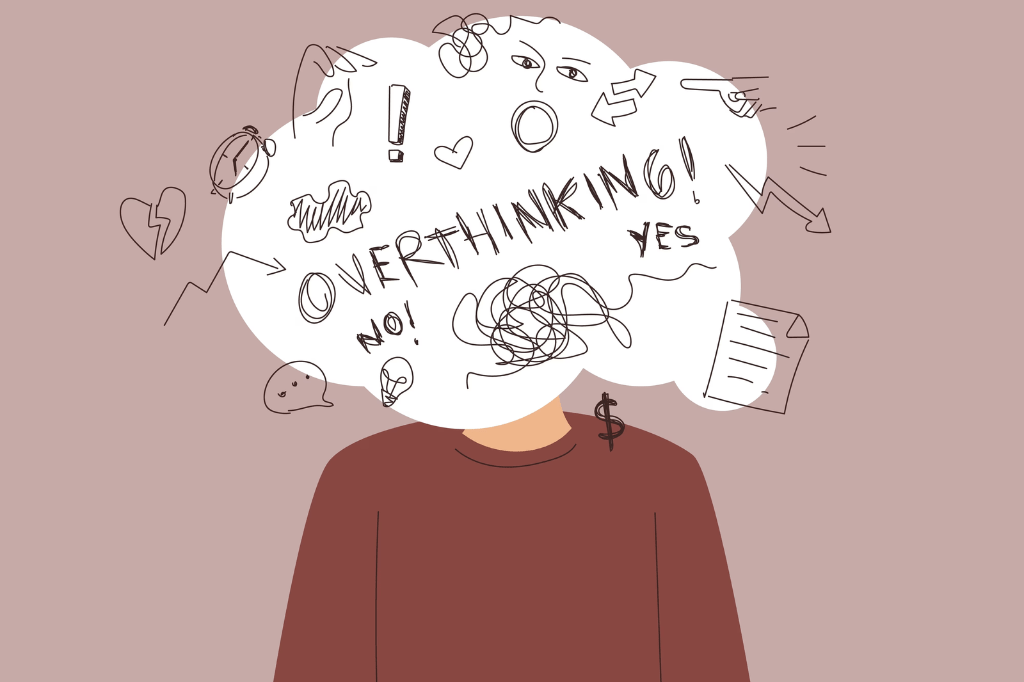
We’ve all done it—gone down a mental rabbit hole, turning the same thought over and over like a rock in our hands. “Did I say the wrong thing?” “What if they misunderstood me?” “Why can’t I just stop thinking about this?”
Welcome to the world of overthinking. It’s exhausting, it’s distracting, and honestly, it can make you feel like your own brain is working against you. But overthinking isn’t just in your head—it’s something that happens in your brain chemistry, your body, and your emotional memory. And the good news? Once you understand where it comes from, you can learn how to soften it. How to slow the spiral and find some peace.
So, what actually causes overthinking? Why does your brain hold onto certain thoughts? And what can you do to turn down the noise when it gets loud?
What is overthinking?
Overthinking is when you can’t stop analyzing, replaying, or worrying about something—usually to the point that it interferes with your mood, sleep, focus, or decision-making. It’s that loop you get stuck in, when your brain feels like a broken record.
It can show up as:
- Rumination (replaying the past)
- Worry (fearing the future)
- Self-doubt (questioning your worth or choices)
- “What if” spirals (imagining the worst-case scenarios)
The problem isn’t thinking—it’s the stuckness in your thinking. When your thoughts become repetitive, circular, or harsh, that’s when overthinking starts to take a toll on your mental and emotional well-being.
Why do we overthink?
There are a few things happening under the surface when you’re stuck in overthinking mode.
First, the brain doesn’t like uncertainty. It tries to predict and control outcomes, even when it can’t. Overthinking is your brain’s way of trying to find “safety” in a situation by overanalyzing it—even if that makes you feel worse.
Second, overthinking activates your stress response. When your brain senses something might go wrong (even if it’s just a social interaction), it flips into problem-solving mode—releasing cortisol and keeping you on high alert.
Finally, if you’ve ever experienced trauma, rejection, or failure, your brain might be wired to scan for danger. Overthinking can be a learned self-protection strategy. It’s your mind saying, “If I can anticipate the hurt, maybe I can avoid it next time.”
But the truth is, overthinking doesn’t usually protect you—it just leaves you mentally and emotionally drained.
What are the signs you’re overthinking?
You may be overthinking if you:
- Replay conversations or situations in your head
- Struggle to fall asleep because your thoughts are racing
- Feel mentally exhausted even if you haven’t “done” much
- Avoid making decisions for fear of getting it wrong
- Second-guess things you already decided
- Worry about things that haven’t happened (and may never happen)
Sometimes, you might even notice physical symptoms: tension headaches, stomachaches, trouble breathing deeply. That’s because your brain’s stress signal doesn’t stay in your head—it moves through your whole body.
How to stop overthinking?
There’s no magic off switch—but there are ways to train your brain to soften the volume and come back to the present.
1. Notice the spiral – Start by simply recognizing when you’re in it. Say to yourself, “This is overthinking. I don’t have to follow this thought right now.” That tiny pause creates space between you and your thoughts.
2. Ground yourself in the present – Come back to your body: feel your feet on the ground, your breath moving in and out, the temperature of the air. Ask: what’s real right now?
3. Move your body – Sometimes you can’t think your way out of overthinking—you have to move. Go for a walk. Stretch. Do jumping jacks. Anything that brings your body into motion helps reset your brain.
4. Get the thoughts out – Journaling can be surprisingly powerful. When you write down what’s in your head, you don’t have to carry it all inside. It also helps you notice patterns: Are these the same worries again and again?
5. Limit decision fatigue – Overthinkers often struggle with “analysis paralysis.” Try reducing the number of small decisions you make each day (like what to wear or eat), so you have more mental energy for the ones that actually matter.
6. Challenge your thoughts – Ask: Is this thought helpful? Is it even true? What would I say to a friend who felt this way? Learning to talk back to your thoughts (kindly) can help break their grip.
7. Practice self-compassion – You are not your thoughts. And your worth is not determined by how perfectly you handle every situation. You’re human. You’re learning. Be gentle with yourself.
Frequently Asked Questions about Overthinking
Why can’t I just stop thinking?
Your brain is wired to think—it’s what it does best. But sometimes, that thinking becomes unhelpful. The key is learning how to redirect your thoughts, not eliminate them.
Is overthinking the same as anxiety?
They’re closely related, but not identical. Overthinking is a symptom of anxiety—but you can overthink even without a diagnosed anxiety disorder.
Why do I overthink at night?
At night, your distractions fade and your mind has more space to wander. Your brain may also be trying to process emotions or decisions you didn’t fully deal with during the day.
Can overthinking make you sick?
Yes. Chronic overthinking can contribute to stress-related issues like headaches, insomnia, stomach problems, and even weakened immune function.
How do I stop overthinking in relationships?
Try to focus on direct communication, stay grounded in facts over assumptions, and remind yourself that you are worthy of love even if things feel uncertain. If insecurity is running the show, working with a therapist can help.
Conclusion
Overthinking doesn’t mean you’re broken. It means you have a sensitive, active mind that’s trying to make sense of the world—and protect you. But you deserve peace, too.
Learning to quiet your brain isn’t about never thinking. It’s about learning how to slow down the spin, return to the moment, and treat yourself with patience.
You don’t have to have it all figured out. You just have to take the next kind step.
Read about: What Is Lovesickness and How Do You Deal With It?


 Xorvex
Leave a reply to Ash Kingston Cancel reply