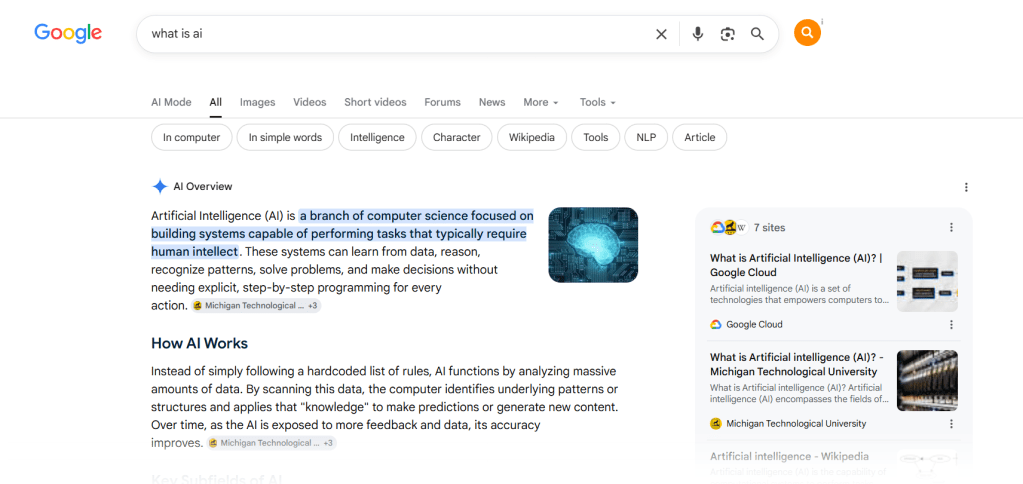
Here’s the number that should worry anyone still running a 2024 playbook: roughly 68% of Google searches now end without a single click to any website, up from around 58.5% just two years ago. When an AI Overview shows up on the results page, click-through rates to the sites underneath drop by nearly 60%, and Pew Research has found that people click a source cited inside an AI answer only about 1% of the time. Search hasn’t just changed, for most queries, it’s stopped sending people anywhere at all.
Marketing playbooks that worked in 2024 are already showing cracks. The way people find brands has splintered across Instagram, YouTube, TikTok, ChatGPT, and now even the browser itself. AI isn’t just changing how content gets made anymore, it’s changing how people discover things in the first place, how they’re targeted, and how the whole path from “never heard of you” to “customer” plays out. Analysts at Gartner had forecast a 25% drop in traditional search traffic by 2026, and in some sectors the actual decline has already landed closer to 40 to 70%.
Below are eight shifts worth building into your 2026 planning now, before they become the thing everyone else is scrambling to catch up on, plus two extra insights on how the smartest teams are actually using AI day to day.
Key takeaways
- Around 68% of Google searches now end without a click, so visibility has to extend beyond ranking position.
- Search is fragmenting across Instagram, TikTok, YouTube, Amazon, and AI chat tools, not just Google.
- The winning use of AI in marketing right now is data analysis and waste reduction, not mass content generation.
- Digital PR and topical authority are becoming the trust signals AI systems use to decide what to cite.
- Live content and multi-language audio are two under-used ways to stand out as everything else gets automated.
How to Adapt Your Marketing Strategy in 2026
1. Stop chasing off-platform traffic
For years, the goal of a social post was simple: get the click, pull people back to your website. That instinct is starting to work against marketers. Platforms like Instagram, TikTok, and YouTube quietly punish content that sends people away, because every click off-platform is attention the platform doesn’t get to monetize. Posts with outbound links often get throttled in reach compared to posts that keep people scrolling.
The fix isn’t to stop linking out entirely, it’s to rethink where the “win” actually happens. Increasingly, the sale, the sign-up, or the brand impression needs to happen on the platform itself, with the outbound link treated as a bonus rather than the entire point of the post. That might mean selling directly through TikTok Shop, capturing leads through an Instagram form, or building a following that trusts you inside YouTube before ever asking them to leave it.
2. Search Everywhere Optimization
Google is no longer the only front door. Classic SEO assumed one thing: people go to Google, type a query, and click a blue link. That assumption is breaking down. People now search directly inside Instagram, TikTok, YouTube, Amazon, and AI chat tools, often skipping Google altogether, especially younger audiences researching products or places to eat.
That means brands can no longer optimize for a single search engine and call it a strategy. The real skill for 2026 is showing up wherever your audience actually types their questions, whether that’s a TikTok search bar, an app store, or a prompt inside ChatGPT. Think of it less as “SEO” and more as “presence everywhere a question might get typed.” That means keyword research now has to stretch across platforms too, not just Google’s autocomplete.
3. The AI slop problem
AI content tools promised speed, but they’re making teams slower, not faster. In practice, a lot of teams have ended up producing more content, faster, that performs worse: bland, generic, interchangeable “AI slop” that readers and algorithms alike are getting better at spotting. Ironically, cleaning up and rewriting AI-generated drafts is now eating up as much time as writing from scratch used to, and studies comparing human-edited content to raw AI output have found the human-edited version pulling in over five times more traffic.
The teams pulling ahead aren’t the ones publishing the most AI content. They’re the ones being selective about where AI helps versus where it quietly does damage to quality and trust.
Bonus: how top performers use AI
Most people assume “using AI in marketing” means mass-producing blog posts or ad copy with a chatbot. The marketers actually getting results are pointing AI somewhere less glamorous: analyzing performance data, spotting patterns in ad spend, and finding waste in campaigns faster than a human team could manually dig through spreadsheets.
In other words, AI’s biggest current advantage isn’t content creation, it’s decision-making support. The unsexy use case, crunching numbers to stop wasting money, is quietly outperforming the flashy use case of letting AI write everything. Digital ad waste alone is estimated in the tens of billions of dollars industry-wide, and this is one of the few areas where AI is already proving its ROI with hard numbers rather than vibes.
4. AI as a discovery engine
ChatGPT, Perplexity, and Gemini aren’t just answer boxes anymore. People are using them the way they used to use Google: to compare products, get recommendations, and make decisions, often without ever visiting a company’s website. Google’s own AI Mode reportedly passed a billion monthly users, with query volume more than doubling every quarter.
If your brand isn’t structured to be picked up, cited, and referenced by these tools, you’re invisible in a growing share of buying decisions, even if your traditional search rankings still look fine. New metrics matter here too: how often you’re mentioned as a source, how fast your brand gains topical authority, and whether you show up in conversations on Reddit, YouTube, or Amazon, since AI systems pull from those platforms when forming their answers.
Bonus: digital PR is the new SEO
Backlinks used to be a rankings tactic. Now they’re doing double duty: the same authority signals that helped a site rank in Google are the ones AI systems lean on to decide which brands are trustworthy enough to cite in their answers.
That shifts the value of digital PR, getting mentioned and linked to by credible outlets, from “nice for rankings” to essential for being recognized as a real source in an AI-driven search landscape. A brand mentioned favorably in a well-known publication is now doing double work: building traditional authority and feeding the exact kind of trust signal that AI models use to decide who to quote.
5. ChatGPT ads are coming
Expect them to behave like Google and Facebook combined. As AI chat tools mature into advertising platforms, they’re likely to borrow the best (and worst) of both search and social advertising: intent-based targeting like Google Ads, mixed with the conversational, in-context feel of a social feed. Marketers who understand both playbooks, the precision of paid search and the storytelling of paid social, will have a head start adapting to whatever ad formats show up here first.
6. Browsers are becoming AI platforms
The browser used to be a passive window onto the web. That’s changing fast, with AI increasingly built directly into browsing itself, summarizing pages, comparing options, and even taking actions on a user’s behalf. That middle step of “browse, compare, decide” that used to require a person clicking through five tabs is quietly disappearing, replaced by an assistant that just does it for them.
For marketers, that means the browser is no longer neutral territory. It’s becoming another surface where AI mediates whether your brand gets seen at all, which puts even more weight on being the kind of source an AI assistant chooses to surface or act on.
7. Live content’s edge
While everyone else is fighting over static posts and AI-generated summaries, live formats are turning into a real competitive edge, think live shopping streams, real-time Q&As, and live video on platforms like Instagram, TikTok, and YouTube. They’re becoming one of the few places brands can still build a direct, unmediated connection with an audience. AI can summarize a blog post in seconds. It can’t fake the trust that comes from a real person answering questions live.
For brands willing to invest in it, live content is turning into a genuine differentiator precisely because it’s harder to automate and harder for AI systems to flatten into a generic summary.
8. Multi-language audio
AI-powered dubbing and voice tools have made it realistic, for the first time, for small and mid-sized brands to release video and audio content in multiple languages without hiring separate production teams for each market. A single piece of content can now reach audiences in several languages almost as easily as publishing it once.
That turns global distribution from a big-budget luxury into something nearly any content team can do, opening up markets that used to be out of reach simply because of translation and localization costs.
Frequently asked questions
What does “zero-click search” mean for marketers in 2026? It means a growing share of Google searches, roughly 68%, are answered directly on the results page through AI Overviews, featured snippets, or knowledge panels, so a brand can be seen without ever getting a click.
What is Search Everywhere Optimization? It’s the idea that people now search inside Instagram, TikTok, YouTube, Amazon, and AI chat tools, not just Google, so brands need visibility across all of those surfaces instead of optimizing for one search engine.
How are top marketers actually using AI right now? Less for mass-producing content, and more for analyzing campaign data, spotting wasted ad spend, and speeding up decisions that used to take a human team much longer to work through manually.
Why does digital PR matter more in an AI-driven search world? Because the same authority signals that used to help a page rank in Google, like credible mentions and backlinks, are now what AI systems use to decide which brands are trustworthy enough to cite in their answers.
The bigger picture
None of these shifts are about panicking and throwing out everything that currently works. They’re about recognizing that visibility no longer starts and ends on a Google results page. Whether it’s a TikTok search, an AI-generated answer, a live stream, or a browser doing the comparison shopping for someone, the brands that show up in 2026 will be the ones that treated “search” as something happening everywhere, not just in one search bar.
Read about: How to Capture Leads on WordPress Without HubSpot or a CRM (Step by Step)
 Xorvex
Leave a comment